
10 KiB
[DC] Rationalist Discworld Novels
-
Author: u/Escapement Ankh-Morpork City Watch*
-
URL: https://www.reddit.com/r/rational/comments/1wu1hk/dc_rationalist_discworld_novels/
-
Score: 15
-
Created: 2014-02-02T20:58:39
Post:
Discworld Series by Terry Pratchett
This was written for newcomers to the series, who may perhaps have heard of it before vaguely but don't know much about it. There are a lot of 'rationalist' themes present in various Discworld books, and as such some of those books are very definitely worth a read for people interested in 'rational' literature.
MOST of Terry Pratchett's work qualifies as deconstructionist - deconstructing and subverting popular tropes of everything from genre fantasy to modern day institutions to popular culture of all sorts
Finally, most of Pratchett's books are really worth reading, even those non-rationalist books. The worst of them is 'decent and readable', while the best are some of the funniest, most poignant, and most intelligent fantasy ever written in English. It's really good stuff, in short.
For reference, the big chart of suggested Discworld reading order is a really good resource when deciding what to read next.
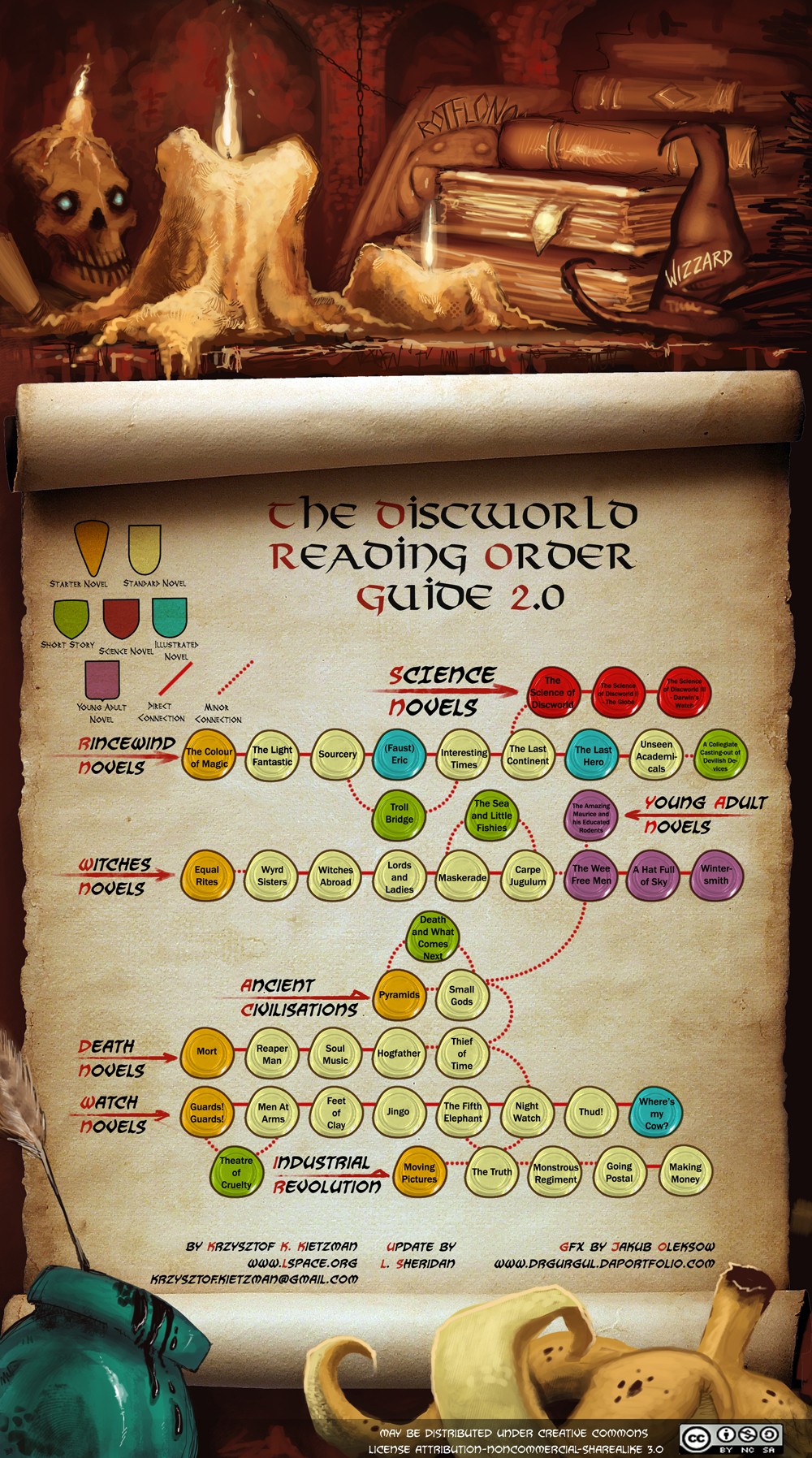
For a rationalist, there are two main series that are rationalist in some sense - the Watch series and, to a lesser extent, the Witches series. That said, the best entry point for the books as a whole for general reading is Small Gods. Small Gods is a mostly independent novel from the rest of the series, and the characters and specific location within the overall setting are not revisited, making it a good book to read at any point; it also is extremely strongly written and interesting. There is some interesting analysis of how a phenomenon similar to the LW affective death spiral causes an organization to become devoted to self-perpetuation over it's nominal goal, and some interesting commentary on religion as well as some interesting planning and plotting, but it's not very rationalist overall.
From there, arguably the most rationalist and one of the most interesting sets of stories is the Watch Novels, starting with Guards! Guards! In these novels, each novel is mostly structured as a mystery, and opportunities for the author to drop hints beforehand, and for characters to figure things out, both abound - the stories are mostly (with exceptions being to some extent the first and the last two last books) puzzles that can be solved beforehand. Night Watch in particular is exceptionally well-written, and if not extremely rationalist in terms of being a puzzle-solving plot it does show an intelligent protagonist using limited resources very effectively.
One warning: Other than the Watch books, the first book (or in the case of the Rincewind books, first two or even arguably three books) are weaker than the others in their set. They were written at the start of the Discworld, before Pratchett had as firmly defined setting elements and style, and it causes them to be off-putting. However, if you get to (Faust) Eric, Witches Abroad, Soul Music, or The Truth and are still not enjoying yourself, you should probably give up on that sub-series entirely.
The Witches books have some rationalist elements as well. In particular, some of the characters are particularly keen observers of human nature and illustrate vividly how people tend to think, albeit not in particularly scientific terms. They are not usually puzzles or mysteries, though, with the noticeable exception of Maskerade, which definitely is. These often examine and deconstruct the intersection between fiction and people, i.e. how people's beliefs and thoughts in/about fiction influence them.
The Rincewind novels are entertaining but basically antirationalist - everything is madcap adventures of an incompetent wizard, who gets through by luck rather than skill, and who has no ability to be predicted beforehand because nothing is foreshadowed. Can occasionally be really funny, but not nearly as easy to recommend as the other series.
The Death novels are somewhat interesting from a transhumanist perspective as a portrayal of death in a not-strictly-negative light, but again are not particularly puzzles and often don't have any particularly illuminating bits about human thought/nature. They are often gorgeously written, however, and are definitely worth a read on that basis alone.
The Industrial Revolution is mostly quite standalone, and in that series The Truth stands out as being particularly rationalist in terms of being a puzzle to solve. To a lesser extent, so is Going Postal. Both are defined by protagonists who intelligently use resources to solve problems.
Of Pratchett's non-discworld books, Strata and Dark Side of the Sun are both sci-fi adventures that imitate Rincewind in lack of foreshadowing and predictability in favor of luck and random chance, and are not really worth reading, being substantially clumsier in execution. Good Omens is an amazing collaboration between Pratchett and Gaiman, but the target of a great deal of it's deconstruction (mainly Christian escatology, with some general Christian theology) is the sort of thing that most readers of this review already don't bother to even consider taking seriously. However, it is some of the most funny and amazingly well-written fiction Pratchett ever produced, so I strongly recommend Good Omens. The fact the overall message of Good Omens is very pro-humanist helps. Pratchett's remaining works are mostly ignorable, but Nation in particular is probably worth a read.
Suggested 'most rationalist' books:
-
Guards! Guards!
-
Men At Arms!
-
Feet of Clay
-
Jingo
-
The Fifth Elephant
-
Maskerade
-
The Truth
-
Going Postal
However, most of the non-rationalist books are still definitely worth a read, and not reading them would IMO be a mistake.
The last few Discworld books (starting with Unseen Academicals, IMO) are not up to par with earlier books. I suspect this is as a consequence of Terry Pratchett's early onset Alzheimers.
The Science of the Discworld books aren't anything special - they offer no insight that is not offered better elsewhere in the nonfiction segments, and the attached fiction segments aren't particularly well written. That said, if you haven't read any popular science books before they may have something interesting to offer you.
TL;DR: Go start with Small Gods, then read the Watch books as defined here, then try other series but be warned the starting books are frequently weaker than the body of the series, and pick up Good Omens (non-Discworld) at some point.
Comments:
u/None [+3] (13 hours later)
I always recommend the books featuring the Witches are rationalist reading material. The Witches modus operandi is simply "get it done" no matter what.
Those books are also full of heroic responsibility (which is best explained in I Shall Wear Midnight as doing all the necessary things no-one else does).
I'm pretty sure the Tiffany Aching novels will end up on my children's bookshelves. (The translated copies, the English copies are for shelves.)
u/Escapement [+3] Ankh-Morpork City Watch (17 hours later)
The Witches books are often written as full of heroic responsibility. They also involve a lot of difficult moral judgements at times - I just recently reread the opening of Carpe Jugulum, and there is a bit about Mr. Ivy and his wife that was still as amazingly written and interesting as ever. Spoilers for Carpe Jugulum's opening (not relevant to the major plot of the book, just gives an idea of characters It really brought up a lot of interesting moral ideas I hadn't considered before about people making decisions for others, and is a well-written way to expose the core of Weatherwax's character - the person who does what is necessary.
I agree about the Tiffany Aching books in particular - great novels for children, but fully readable as an adult. All of his YA fiction still reads well for adults.
That said, I am not sure that merely having heroic responsibility qualifies a piece of fiction as rationalist. They are good books, even great books, with a lot to commend them, but there's not necessarily a lot of rationalist thought involved most of the time IMO. I don't really think semantics arguments are particularly meaningful or helpful in most circumstances, but in this particular case if we start saying "books involving protagonists who do what they need to do no matter what" are "rationalist", it will help dilute the term of any useful meaning it has accrued.
u/None [+2] (a day later)
The Wee Free Men, at least, blatantly exhibits an Appeal to Rationality through its advocacy of "First Sight" (seeing what's really there rather than what you expect) and "Second Thoughts" (noticing when your brain is tricking you) as being the core of magic.
u/alexanderwales [+3] Time flies like an arrow (4 hours later)
Man, I love Discworld. Small Gods is definitely my favorite of the bunch, and I'd definitely give it the title of "most rational". It's funny though, since the Discworld universe runs on rules that aren't really conducive to rationality.
u/lehyde [+1] Nudist Beach (an hour later)
Thank you for posting this guide. Discworld is definitely on my list as I frequently come across quotes from the series on lesswrong and similar places. So I think this will come in handy (first need to finish some other stories, though).