
29 KiB
[Q] Question to rationalist writers: how do you make your stories funny?
-
Author: u/raymestalez *
-
URL: https://www.reddit.com/r/rational/comments/2vg8ki/q_question_to_rationalist_writers_how_do_you_make/
-
Score: 15
-
Created: 2015-02-10T19:54:38
Post:
Hi everybody! =) I'm sorry that it is a little off topic.
I'm posting this question on this subreddit because:
- I know that there's a lot of very cool writers on this subreddit, and many of you are really good at making your stories hilarious.
- People on this subreddit are likely to be good at analyzing and understanding their thinking process.
My goal is to write stories that are both rational and very hilarious(like HPMOR), but I'm completely stuck at writing comedy, I just don't understand how this process works.
Can you share some insights and ideas on how do you make your stories funny? What process are you going through, how did you learn to come up with funny jokes/ideas/premises?
I'm trying to understand the way you think when coming up with a funny idea, and what can I do to learn that as well.
Any of your thoughts on this topic, any hints on how this process might work would be really helpful =)
If you have any articles/books/other resources that can help with understanding how to write comedy - please share them too)
Comments:
u/alexanderwales [+21] Time flies like an arrow (an hour later)
Seconding that it mostly comes naturally. Now, with that said:
If you're trying to make something funny, the easiest well to draw from (in my experience) is the unexpected. Reversal or subversion of expectation forms the basis of a lot of humor. Here's one of my favorite jokes of all time:
Two hunters are out in the woods when one of them collapses. He doesn't seem to be breathing and his eyes are glazed. The other guy whips out his phone and calls the emergency services. He gasps, "My friend is dead! What can I do?" The operator says "Calm down. I can help. First, let's make sure he's dead." There is a silence, then a gun shot is heard. Back on the phone, the guy says "OK, now what?"
So with the caveat that explaining a joke is a good way to make it not funny anymore, this joke is funny primarily because it's a reversal of expectations (but also because of taboo breaking). This kind of humor is pretty easy to set up.
Let's do a small workshopping example:
A boy and a girl meet for the first time. There are lots of cliches around this, because it's a common thing to happen in fiction. We'll give it a vaguely fantasy setting, both principle characters are in their late teens, etc. We can decide everything else later, but it shouldn't really matter.
Two characters meeting is not interesting by itself, not to mention not funny. What we need (if we want humor) is to subvert our expectations of this meeting. The best way to do that is to first set up some expectations to subvert. So let's say that our male character is something like a hero, and our female character is a damsel in distress - which is a complete cliche, but a cliche that we can make work for us by subverting.
So the hero "meets" the princess as she's unconscious and slung over the back of some brute walking down the road. They're moving in opposite directions. In the non-funny version of this, the brute stops in his tracks, the hero defeats him, and stays with the princess until she wakes up, whereupon some Plot happens (the hero escorts her back to her castle just in time for them to see it burning to the ground from a dragon attack, or whatever). In the funny version, we start adding in subversions. (note: these are ideas meant to be taken in relative isolation - you run into both timing and logic issues if you try to use every subversion that comes to you)
- The brute doesn't stop at all. He's whistling a merry tune, and nods to the hero as though this is just part of his normal day.
- The hero attempts to stop the brute, but they get into an argument instead of a fight. First ideas: the brute might argue that the more heroic thing might be to wait for the brute to get to his camp, or that the hero should wait for the damsel to wake up so that she can see the rescue (if you're going really silly, they can agree to sit down together until that happens), or perhaps the brute will argue that the damsel is not a damsel at all, but rather his drunken sister despite appearances (and perhaps, if the hero presses for a fight, the brute might actually be telling the truth).
- The brute and the hero fight, but the hero is inept - he's hardly had any training with his sword. It's usually better for the protagonist to have a flaw, because self-deprecating humor is more enjoyable - the brute being soundly and immediately trounced is less funny, unless ...
- The hero outclasses the brute by several orders of magnitude, and yet the brute keeps spoiling for a fight. The hero is worried about hurting the brute, or worried about hurting his feelings (a subversion of the expectations that a fight is about winning).
- The princess, when rescued, is not what she seems. She wasn't helpless, she was just pretending to be unconscious so that the brute would bring her back to the hidden camp - as soon as the brute has been dispatched, she pops up from the ground and berates the hero for spoiling her plan while at the same time pulling hidden daggers from within her dress (this is a good idea to use in tandem with a clearly outmatched hero, because it reverses the expectation that the hero saves the princess).
- The princess is not a princess at all - she's another hero dressed up as a princess as part of some convoluted plot, or a foreigner who only looks like a princess because of the way that he dresses.
I'm not terribly sure that advice is useful to you, but hopefully it helps.
u/PrinceofMagnets [+3] (14 hours later)
(the hero escorts her back to her castle just in time for them to see it burning to the ground from a dragon attack, or whatever).
Where is this story?!
I need it.
u/kuilin [+1] (19 hours later)
See? It works!
u/IomKg [+1] (16 hours later)
I think this is a pretty good explanation of how humor works.
Though I think a step is missing from your explanation..
You give a situation, and then examples of how it could be made funny, good examples, but you don't show the process of actually getting them(which i suspect is the hard part that won't come naturally to most people).
Maybe adding a step where you list all of the assumptions\cliches that apply, and then offer suggestions of how to subvert them. After which you get a list of subversion where you should be able to tell which are funny and which are not..
Also, you'r hunters joke would fit senyuu like a glove.. :P
u/alexanderwales [+1] Time flies like an arrow (a day later)
Well, humans skip a lot of steps. A full process would look something like this:
- Establish a situation.
- Define the expectations/assumptions.
- Generate ways of subverting/inverting/reversing those expectations/assumptions.
- Test which of those are funny and discard those that are unfunny.
But no one would ever write humor like that - it's an algorithm that a computer would use to brute force it. And because humans are good at pattern-matching (relative to computers) we can mostly just skip past all of the variations that intuitively aren't funny.
And I'm skipping over a whole lot - comedy isn't just about the unexpected. Here's one of my other favorite jokes:
Two muffins are in an oven. One of them says, "It's getting hot in here." The other says, "Holy shit, a talking muffin!"
That's an easy joke to dissect - it's funny because it has two layers of humor to it, the first being the subversion of the joke's premise and the second being the subversion of the muffin's self-awareness. But why muffins? I've actually thought about this a lot - this is a common joke, and I've heard it many, many times. But it's always been muffins. In theory, the joke works the same no matter what the two things are, but in practice, the fact that they're muffins lends something non-obvious to the humor. Is it because muffins are traditionally thought of as bland? Is it something to do with the sound of the word "muffin"? Jokes undergo memetic mutation, but this joke always stars two muffins, which says to me that it must be the most funny variant. But I don't know why.
There's this whole field of "intrinsic" comedy that I have a lot of trouble with. If someone gets hit in the face with a fish, and that fish is named, 90% of the time that fish will be a mackerel. If there's a vegetable, it'll probably be a zucchini, in disproportion to their representation among vegetables. Partly this must be down to the sounds that they make, but saying that a hard "K" sound is inherently funny only raises further questions.
Anyway, if you really want to get good at comedy (and I don't claim that I am), what you need to do is develop that instinct, and the best way to do that is not by following a formula, but by watching and reading enough comedy that you can begin to have those patterns etched into your mind without having to bother with the intermediary stuff.
u/IomKg [+2] (a day later)
Well, humans skip a lot of steps
After they learn the skill? sure.. But the OP seems to be having difficulties with the skill. And I think while reading you explanation will give them good understanding it might cause a person attampting to follow your advice to kind of get lost in the "ok, so what do i do now?" type of situation..
But no one would ever write humor like that - it's an algorithm that a computer would use to brute force it
Well long term you are probably correct, but before internalizing the process I think its totally reasonable to use such brute force way. And actually
we can mostly just skip past all of the variations that intuitively aren't funny.
if by variations you are talking about the subversions then i agree, you won't actually need to write all of them down because by the time you think about them you will probably already figure out if they are funny or not, but the assumptions? less so, and every assumption could have more then one possible subversion, so the end result is that doing this consciously would be too hard in my opinion..
And I'm skipping over a whole lot - comedy isn't just about the unexpected
No argument there, Its a pretty interesting field... But i think you did a pretty good job in explaining one form of comedy, only you skipped some step which i thought would make your post a bit more "complete"..
u/MadScientist14159 [+1] WIP: Sodium Hypochlorite (Rational Bleach) Eventually. Maybe. (3 days later)
Actually, I'm pretty sure I read somewhere that a hard K is inherently funny, because the shape of your mouth when you say it is similar to the shape of your mouth while laughing, or something like that.
u/thecommexokid [+1] (5 days later)
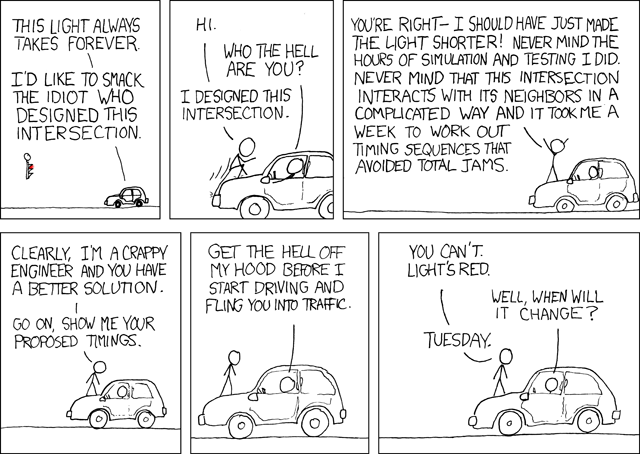
I also have long maintained that "Tuesday" is the funniest day of the week. Try imagining this comic with the 6 other possible punchlines; Tuesday is simply the funniest.
u/xkcd_transcriber [+1] (5 days later)
Title: Long Light
Title-text: You can look at practically any part of anything manmade around you and think 'some engineer was frustrated while designing this.' It's a little human connection.
Stats: This comic has been referenced 55 times, representing 0.1059% of referenced xkcds.
^xkcd.com ^| ^xkcd sub ^| ^Problems/Bugs? ^| ^Statistics ^| ^Stop Replying ^| ^Delete
u/ishaan123 [+5] Sidebar Contestant (9 hours later)
Let's start with an example in children's fiction, rather than rational fiction, because it is simpler and "innocent" in that it doesn't require layers of reference to understand.
Here, I'll write a quick children's punch line:
The elephant lumbered over eagerly. "Let me help!"
STOMP STOMP
"No! No!" screamed the mice.
STOMP STOMP!
^ This is just a punch-line. In order to actually be funny, it needs a build up. The funny part is that the elephant thinks he's being helpful, but the mice are panicking. There is humor in the dissonance of expectations. You can imagine reading and miming the STOMP STOMP part in a way that make children laugh. But it's not truly funny yet because we don't have insight into the mental process of the elephant or the mice, so the dissonance is pretty superficial at the moment.
Try imagining various build ups right now? Maybe the mice had just been painstakingly doing something really delicate, like making a card castle. Maybe the elephant has been trying to help people the entire story, maybe he just keeps sticking his big nose into things and they keep getting worse. (I'm intentionally keeping this vague to prompt the reader to imagine humorous build-up scenarios. In real life, the build up is life itself, and you deliver the punchline, but in fiction while jokes do spontaneously emerge from plot it can also happen in the reverse way... a funny situation might float into your head and you must think up a way to build up to it).
So, two steps for Dissonant Dialogue: 1) Audience must understand the state of mind of both characters 2) the two characters completely misunderstand each other (not like, an argument. More like silly way that probably wouldn't happen in real life).
Now lets talk about Peekabo. Everyone knows its a game. The parent pretends to be a character who hides, and pops out. The child pretends to not know, and be surprised. Everyone knows what's going on, but there is a misunderstanding between the characters of the game. It's basically identical to the elephant example - the writer and audience both know what's going on, but we're playing at a pretend-elephant who is clueless.
Now let's reduce the adult jokes of HPMOR down to "peekaboo". Since we're all good reductionist philosophers here, we understand how Harry thinks about physics. We understand how McGonagall thinks about magic if we read the Harry Potter...but while reading we pretend to be (mentally simulate) Harry and McGonogall in turns, and Harry does not know that it's totally mundane to turn into a cat. McGonogall does not know why it's reality-breaking to turn into a cat.
I explained the "Dissonance Dialogue" brand of comedy here, but I also used several other types of humor. Admittedly, none of these are HILARIOUS, but you might have at least felt a little smirk in the back of your mind when you first read (or visualized) them:
Physical comedy STOMP STOMP: it's dissonant because you're not supposed to walk around stomping on things, but one of the characters thinks its okay to do so. Violation of social expectation is inherently funny. That's why streakers are "funny"...what are they doing? They're just being naked, in the context that they're not supposed to be. That's the entire joke.
Wordplay: maybe he just keeps sticking his big nose into things, it's dissonant because I pretended to innocently use an idiom, but we secretly understand I was also literally referring to the size of the elephant's nose. It's punny to use idioms literally. Coming up with these happens spontaneously (this one was an accident) and if you asked me to come up with them on demand, i couldn't.
Sarcasm: Since we're all good reductionist philosophers here - speaking about "good reductionists" alludes to "good Christians" or "good Muslims", drawing a funny parallel between two dissimilar groups. Someone or something is the butt of the joke here ...and this is why Death of the Author is at least partly a Valid Thing: I honestly have no idea what this joke really meant and your interpretation might easily be more correct. Is this self-depreciating humor directed at reductionists like myself? Is it mocking religious folk's terminology and characterizing them as quaint? Was it a comment on the homogeneity of the community? I'm not sure - I made it myself and I felt the "playful" emotional state while writing it, yet I didn't even realize it was a joke until reading it a second time. I think people just naturally weave these little bits of "play" into speech, with multiple complex meanings that somehow bypass explicit processing, and that's why sarcasm is often difficult to explain to someone from another culture. Complex humor is often funny in ways that no one can quite articulate.
As you go higher up the "sophistication chain" (sarcasm, dark comedy, anti-jokes) that requires more and more cultural knowledge in order to be "in on", the audience of people you'll have laughing shifts, but you'll notice all of these inherently involve a pretense that everyone laughing see through (except for the sarcasm, which sorta-kinda sometimes implies actual hypocrisy that people can see through.)
It's all about play behavior. Your friend spontaneously steals your hat and wears it. Two dogs tussle over a bit of rope. All this play behavior involves pretend characters doing pretend things which do not signify what they really mean. (The dogs don't actually care about the rope, your friend hasn't truly stolen your hat). Of course, in a story everything is pretend, but only some things are humorous... what's the distinguishing factor?
"The elephant wanted to help, but couldn't because he was big and clumsy" is gradually moving to "Serious" territory, though not totally serious because we still are dealing with elephants acting like people. "The boy was eager to please, but too clumsy to be of any help" is basically the same thing..but it's no longer a laughing matter because the boy is sad and so is the audience. Everyone, fictional or otherwise, is on the same, sad page. No dissonance. We actually feel sad about the fictional boy and empathize. (And I think this is one of those uniquely human adaptations, to create pretense that isn't all fun and games).
Whereas in the case of the two dogs, both dogs know that even though they're pretending to fight, it's actually all great fun. It's maybe not a joke but it has the fundamental, playful, pretending core of a joke, and that's what makes a story humorous.
(Thanks for prompting me to write that out, I had never to this degree explicitly thought about this issue before! Sorry it is winding.)
u/None [+3] (44 minutes later)
Hilarious person here. Mostly it comes naturally. Read funny things closely, see how the humor works, and try to replicate it. Mostly it just comes naturally, but the trick is to pay attention to every that is funny or could be funny, including and especially other people's stuff.
If comedy really baffles you so, it might not be your thing. I've never heard of someone who absolutely wasn't funny and studied comedy to become so successfully. I'm sure it could be done, but I've never heard of it.
u/raymestalez [+1] (an hour later)
Thank you for the reply! I'm pretty sure that everything that can be done can be learned, I just haven't figured out how to do that with comedy yet.
The thing is that I actually can make jokes spontaneously(in a conversation or while thinking on random things), just not intentionally. Unfortunately, to write funny things I need to be able to make jokes that fit into a particular story/scene, and that doesn't work at all....
I absolutely love comedy, and I watch it all the time(that's why I want to write it so badly). It's weird, you'd think that brain would pick up on the pattern by now, it's interesting that it doesn't....
u/None [+4] (an hour later)
I was going to take some examples from HPMOR, Harry Potter and the Natural 20, and my own writing to see if it could help you, but then I realized breaking down what makes something funny isn't the same thing as knowing where the funny comes from. If you told me to "write something funny," I wouldn't know what to do, and I'd probably fail. But as I conceive a story, comedic possibilities are just there. And when I imagine a scene, I can just hear the dialogue spiraling off into something absurd.
It might help to have a comedic setup. I write funny things, but not everything I write is funny. Sometimes it's very serious, and when I write serious things I don't have to force myself not to write jokes. The jokes simply don't come. Because they shouldn't be there. Because the setup isn't funny.
HPMOR, Harry Potter and the Natural 20, and my own magnum opus get a lot of comedic mileage out of a fish-out-of-water scenario. Harry sees the magic, that is not physically impossible, he explains with big words that an eleven year-old shouldn't know, cue laughter. Milo applies game logic to Harry Potter world, with silly results. Hariya Potter lectures the Hokage on the Geneva Convention. All these things are funny, but they're natural outcomes of the premise. Milo doesn't have to force jokes about D&D. He is D&D, and his character played totally straight is a comedy machine. Similarly, it's totally in-character for HJPEV to babble about how turning into a cat violates...everything, just all of the things. And I have to imagine that at that point, if you know where the scene is going and you have a strong grasp of the characters, the jokes write themselves.
So maybe you should look at your premise and your characters. Does the premise have comedic potential? And do you know your characters well enough for the comedy to come naturally as a function of their interacting with the premise?
u/Nighzmarquls [+3] (an hour later)
On my front I find delivery is everything. But also I think we probably have different talents for kinds of comedy. I'm good as a foil/straight man/satirist. I give the impression of great seriousness. So I try to cultivate and use that in most of my attempts at comedy.
A useful thing to do is pay attention to what you might do that makes others laugh (either at our with you) my odd perspective and somber kind of tone works real well for snark (But I endeavor to do so nicely).
Really comedy has a lot of flavors, there is probably a branch of it your suited too.
u/None [+3] (an hour later)
You might like "Jokester" by Isaac Asimov. (pdf)
u/raymestalez [+1] (an hour later)
Thanks! Reading it)
u/EliezerYudkowsky [+3] Godric Gryffindor (6 hours later)
This mental process is mostly opaque to me, but one interaction with the 'rationalist' part of rationalist fiction comes from the Double Act aspect of comedy, in which the rationalist can either play the Straight or Only Sane Person via bringing a logical perspective to an illogical situation, or the Banana Person via bringing a confusing foreign perspective or thinking outside the box.
To introduce the setup for a comedic situation, you need both craziness and the perspective that reacts to the craziness. I don't have a deliberate theory behind this; both the craziness, and writing the reaction to that craziness, come naturally to me. But it's the best advice I can offer.
u/autowikibot [+1] (6 hours later)
#####
######
#### Double act:
A double act, also known as a comedy duo, is a comic pairing in which humor is derived from the uneven relationship between two partners, usually of the same gender, age, ethnic origin and profession but drastically different in terms of personality or behavior. Often one of the members of the duo—the straight man, feed, dead wood, or stooge—is portrayed as reasonable and serious, while the other one—the funny man, banana man or comic—is portrayed as funny, less educated or less intelligent, silly, or unorthodox. If the audience identifies primarily with one character, the other will often be referred to as a comic foil. The term "feed" comes from the way a straight man is wont to set up jokes and "feed" them to his partner.
====
^Interesting: ^Double ^Act ^(TV ^film) ^| ^Double ^Act ^(novel) ^| ^Pegando ^con ^tubo ^| ^Pepe ^the ^King ^Prawn
^Parent ^commenter ^can [^toggle ^NSFW](/message/compose?to=autowikibot&subject=AutoWikibot NSFW toggle&message=%2Btoggle-nsfw+cohpg7b) ^or [^delete](/message/compose?to=autowikibot&subject=AutoWikibot Deletion&message=%2Bdelete+cohpg7b)^. ^Will ^also ^delete ^on ^comment ^score ^of ^-1 ^or ^less. ^| ^(FAQs) ^| ^Mods ^| ^Magic ^Words


u/Charlie___ [+2] (2 hours later)
So, a few years ago I wrote two one-act plays, one year apart.
The first play was awful. Frankly, I've blocked large parts of it from my memory. Why? I wasn't good enough at writing to start having fun with things. I didn't understand what made different characters interesting to the audience, and I didn't do enough exploring the range of plot ideas to just pick out the fun ones. And I wasn't ridiculous enough.
A year later the new play was called "Hammerface," and was much better. Characters that actually had distinct personalities and funny traits, more absurdity and extremes, a light tone. It was, like, comedy.
To get from point A to point B, step one was thinking a lot about what I wanted from my writing and what had to change - see above. It may be helpful to have an example of the sort of thing you want to achieve that you refer to while thinking about what to work on. My solo practice was mostly writing character monologues. The most useful practice, though, was writing a scene with an experienced partner.
u/OffColorCommentary [+2] (7 hours later)
Scot Adams, the creator of Dilbert, has a formula he's recommended. He published it in one of his books, which is more extensive, but more conveniently he blogged a copy too.
Apparently the writer of Pearls Before Swine follows these rules much more strictly than Scot Adams himself even does, and it's worked out pretty well for him.
That's still just a tool in a bag; humor is a craft, and has a lot to it. For example, you can watch someone like Jay London tell merely okay one-liners and knock an audience out laughing with the quality of his delivery. A lot of his technique is built out of timing and expectation-handling, which are both outside the lines of what part of his act looks like a joke.
u/AndrewConway [+1] (8 hours later)
Humour often comes from situation. One particularly rational situation ripe for humour is when a character makes some long chain of (perfectly reasonable) deductions, based upon some "fact" that they believe for reasonable reasons (involving lack of information), but is not actually true.
This works particularly well if they are interacting with other people who are aware of the truth, but don't know that the original character is unaware of it.
There is the rather nasty variation of this where rational A, B and C are talking; A & B know something that C doesn't, and A & B amuse themselves having a conversation that will be misinterpreted by C. [This is also done without B].
Most people don't trust long chains of logic, as they assume they will make a mistake somewhere. Many people who think of themselves as smart and/or rational will erroneously trust themselves to long chains of logic.
u/None [+1] (15 hours later)
... the same way non-rationalist writers make things funny?
Sorry, I've never tried to introspect on how to generate jokes before.