
31 KiB
[BST] Help me abuse physics
-
Author: u/Sagebrysh Rank 7 Pragmatist*
-
URL: https://www.reddit.com/r/rational/comments/3g7fqw/bst_help_me_abuse_physics/
-
Score: 7
-
Created: 2015-08-08T03:14:45
Post:
In my universe, I have established in canon that its possible to create an Over-Unity Engine using a special material called aetherium.
It's currently known that you can use a very simple application of Aetherium oxide to produce lift. This is done by mounting a mass of Aetherium oxide to the end of a flywheel. On the lower half of the swing, an electric current is run through the material to reduce its mass. As the mass swings upwards, the energy is discharged and the weight of the material returns. This imbalance in force produces lift.
Now, I'm certain that using similar principles, a form of over-unity engine could be conceived of that somehow outputs more energy then it takes to run, but I can't actually puzzle out in my head what such a thing would look like. I imagine broadly speaking, it would be some sort of mechanical engine that when electrical current is applied to some portion of it, produces torque to power a generator, in the process producing more power then was input in the first place. This is of course in violation of real world CofE, but in my fictional world, it should be possible given the special characteristics of the fictional material. It's a case of minovsky physics, and I'm curious how far it can be taken. Its meant to be broken, and I'm curious as to how exactly one could go about breaking it.
Comments:
u/STL [+7] (an hour later)
I can't actually puzzle out in my head what such a thing would look like.
You can easily generate energy with this. Have a dumbbell with two spheres (lumps; shape is irrelevant) of aetherium oxide. Rotate the dumbbell. After a sphere gets past the bottom and begins to ascend, run the current to reduce its mass. This is easy to lift. As a sphere gets past the top and begins to descend, stop the current and let it return to normal mass. In this manner, the falling sphere is always more massive, so you've produced a torque to rotate the dumbbell. You need only pay for friction and the electric current; the rest can be extracted through a generator.
u/Sagebrysh [+2] Rank 7 Pragmatist (8 hours later)
How would you take advantage of that outside of a gravity well? Would you mount the entire machine to a centrifuge ring?
u/STL [+3] (14 hours later)
Sure.
u/SvalbardCaretaker [+2] Mouse Army (16 hours later)
If you do this you need to have a counter-rotating thingy on the opposite site on the ring so you dont get movement of the ring.
u/Sagebrysh [+4] Rank 7 Pragmatist (16 hours later)
unless you want movement of the ring. The mass gradient could also be used to produce thrust as well as power.
u/DCarrier [+4] (5 hours later)
Any reactionless drive with an efficiency greater than 300 MW/N can be used as a perpetual motion machine. W/N also works out to m/s. If you have something moving faster than its efficiency, it produces more kinetic energy then it uses energy, and if you add in regenerative breaking you have a perpetual motion machine.
Others have pointed out a more efficient way to do it in your case, but I like to answer the general problem.
u/SvalbardCaretaker [+1] Mouse Army (8 hours later)
Sorry but you must surely mean 300mW/N?
u/DCarrier [+1] (14 hours later)
300 megawatts per newton. Or more precisely, 299,792,458 watts per newton, which is the speed of light in W/N. At 300 mW/N, you only have to be moving faster than 300 mm/s to make a perpetual motion machine. At 300 MW/N, you'd have to be moving faster than 300 Mm/s, which is impossible.
u/None [+2] (14 hours later)
Can you step me through the math on this?
u/DCarrier [+1] (14 hours later)
Here's a particular example. I can prove the general case with calculus if you prefer.
Suppose we have a reactionless drive with a mass of 1 kg that runs at 1 MW/N. It's moving at 2,000,000 m/s.
E*k0* = 1/2 mv*0*^2
= 1/2(1 kg)(2,000,000 m/s)^2
= 2,000,000,000,000 J
After an impulse of one Ns of impulse, which takes, 1 MJ,
v*1* = 2,000,001 m/s
E*k1* = 1/2 mv*1*^2
= 1/2(1 kg)(2,000,001 m/s^2)
= 2,000,002,000,001 J
∆E*k* = 2,000,001 J
But it only took 1,000,000 to run.
u/General_Urist [+1] (a day later)
Your math is correct, but one thing that needs to be added:
while the point at which speed=efficiency is the point where you begin to violate conservation of energy, the "break-even point", assuming you were accelerating purely using the drive from 0 m/s, is actually at speed=2Xefficiency.
Here's a way to visualize it graphically. You have a vehicle, of mass m with a reactionless drive of efficiency E, currently at rest. (v=0). You then apply constant power P to the reactionless drive for an indefinite amount of time.
While doing this, plot a graph (energy over time) of both the total energy consumed by the drive and the kinetic energy of the vehicle.
The "energy consumed" graph will be linear (y=Px, where x is in seconds). However, as kinetic energy varies with the square of speed, and speed is increasing at constant rate (assuming purely Newtonian physics), the "kinetic energy" graph will be quadratic. (I can't be bothered to shoehorn the full equation into Reddit formatting, sorry)
at any time value, the derivative of the 1st line represents "energy in", while the derivative of the second line is "energy out". It is true that v=E is the point where the graphs of the two derivatives intersect and efficiency exceeds 100%. However, at this point the "kinetic energy" graph is at only 1/2 the value of the "energy consumed" graph.
The actual energy vs time graphs only intersect later on, when v=2E. This is important if you actually want to build a legitimate perpetual-motion power-source and not just a science project.
u/DCarrier [+2] (a day later)
That's how fast I need it to go if I start it from a standstill, accelerate it with my reactionless drive, and then bring it to a stop with regenerative breaking. But there's no need to do that. There is no reason to ever slow it below the break-even point. I can just keep running the reactionless drive and the regenerative breaks at the same time to keep the velocity constant, and as long as I'm moving faster than v=E I'll get more energy than I consume.
u/lsparrish [+1] (18 hours later)
At 300 MW/N, you'd have to be moving faster than 300 Mm/s, which is impossible.
Why would that be impossible? Maybe it's more like the sound barrier, which can be exceeded?
u/DCarrier [+1] (18 hours later)
It's the speed of light. No matter how fast your going, light is still moving 300,000,000 m/s faster from your reference frame, and you are no closer to reaching that speed. At the speed of light, kinetic energy is infinite. Faster than the speed of light it's a complex number.
u/lsparrish [+1] (2 days later)
I thought that was only true in a universe where special relativity is true. In a classical universe the kinetic energy at the speed of light (1/2 mv^2 ) is 90 PJ, whereas at double the speed of light it would be the square of that -- still a finite number, albeit a ridiculously high one.
u/DCarrier [+1] (2 days later)
I assumed it was true since you didn't say otherwise. In a Newtonian universe, any reactionless drive can produce energy.
u/None [+7] (24 minutes later)
In my universe, I have established in canon that its possible to create an Over-Unity Engine using a special material called aetherium.
The creation of Over-Unity Engines is energetically favored, and there is a half-life-per-cubic-centimeter rate at which space spontaneously becomes transformed into suns. Once created, they release energy into the regions around them which, while subject to the inverse square law, still provide energy to use to accelerate the process in the surrounding space since it has a higher energy density to use to spontaneously cause the transformation.
Your universe catches on Over-Unity fire and burns down immediately because you made hard vacuum flammable and the kindling point absolute zero. We have thermodynamics for a reason. Don't violate it.
u/ArgentStonecutter [+7] Emergency Mustelid Hologram (7 hours later)
The creation of Over-Unity Engines is energetically favored
That doesn't mean that the process to reach that point doesn't take billions of years and the evolution of systems powerful enough to perform general computation.
and there is a half-life-per-cubic-centimeter rate at which space spontaneously becomes transformed into suns
Objection. Assuming point not in evidence.
you made hard vacuum flammable and the kindling point absolute zero
Objection. Assuming point not in evidence.
We have thermodynamics for a reason. Don't violate it.
Counterexample: Greg Egan's Clockwork Rocket series.
u/None [+4] (14 hours later)
Clockwork Rocket doesn't violate thermodynamics. It eats them from the past with negative infinite temperature. Nowhere in that cosmology does energy come from nothing, but it does sometimes get sucked away from parts that didn't know they were going to contribute and don't know where it went at infinite speed.
No need for billions of years. If you can make a wheel of whatever material he has, then the virtual particles in empty space will happily make one a single particle wide, spin it, come out with more energy than they started with, and not have either particle pair disappear. That's where the fire comes from, unless you change physics in some way. If you want to balance this, make space leaky - energy bleeds off at a steady rate, and perpetual motion machines, naturally occurring and otherwise, are all that saves the universe. Entropic energy isn't merely wasted, it vanishes. You will always have exergy available to perform useful work, but it's getting colder and emptier in here without help from magic.
u/ArgentStonecutter [+3] Emergency Mustelid Hologram (15 hours later)
then the virtual particles in empty space will happily make one a single particle wide
Same objection.
u/None [-2] (15 hours later)
Your objection to "a single particle" is still "billions of years and the evolution of systems powerful enough to perform general computation"? No, you don't need general computation or billions of years for virtual particles to bubble out of the quantum foam. They do that nonstop all the time, and how long they stick around and at what rate they occur at is determined by what temperature it is, how much energy it takes to form them, and how much energy they release. If the temperature is higher than the formation energy, that makes it spontaneous. If the temperature is lower than the formation energy, it happens on a half life determined by a ratio between the temperature available and the formation energy. If the release energy is greater than the formation energy, that makes it catalytic.
u/ArgentStonecutter [+4] Emergency Mustelid Hologram (15 hours later)
Assuming point not in evidence.
u/LiteralHeadCannon [+9] (4 hours later)
This is a very dull and meaningless sentiment, formed out of a reactionary attitude towards crackpots. We have not observed any systems that output more energy than they take in, but this doesn't imply that such a thing is impossible: only that it doesn't spontaneously generate very often - rather like life, which we've only observed one instance of. The lack of something in nature doesn't imply that it's impossible to build - nor does our difficulty in figuring out how to build it.
Conservation of energy is not a wall for humanity to turn back at, but rather a problem for us to solve, like death.
u/Nepene [+6] (13 hours later)
We have extensive experimental and mathematical evidence for a lack of systems that can decrease entropy on net and output more energy than they take in. We have no particular reason to believe that it's possible, any more than we have a reason to believe we'll later discover that creationism is true and gravity is a lie.
u/nerdguy1138 [+3] GNU Terry Pratchett (6 hours later)
You. I like you!
"It's impossible, you say? Try anyway!"
u/Uncaffeinated [+1] (19 hours later)
The difference is that as Harry would say, the laws of thermodynamics aren't arbitrary. According to Noether's theorem, conservation of energy is implied by the symmetry of spacetime.
If you want to get rid of thermodynamics, you have to get rid of a whole framework of elegant mathematical laws.
u/Sagebrysh [+2] Rank 7 Pragmatist (20 hours later)
Not necessarily. Einstein didn't get rid of Newtonian physics, just added additional layers of understanding on top of it.
What sort of universe could allow the creation of an over-unity engine while otherwise looking like our own? How would thermodynamics need to change to take that into account.
One of the other posters had suggested energy was removed from the system as well as entering it, and if the two rates balanced the situation would look like our world does.
Its all fictional, so just run with it. Given the end conditions, what sort of changes to the initial state are required? How do you avoid setting the vaccuum on fire while still allowing an over-unity engine? What sort of alternative physics would you need to make that work?
u/None [+3] (22 hours later)
The universe has two poles, the over unity pole, and the under nullity pole. One side is too hot for anything to exist, energy just pours out dense radiation and particles, and spreads out according to some inverse square law that provides a range of finite values to the universe but approaches infinity as distance to the pole approaches zero. The under nullity pole constantly sucks away energy it doesn't even have, diminishing its surroundings in a reverse of the same law. Nothing can live near there, they freeze and disintegrate into nothing. If a thing doesn't get enough energy, say because it's in the shadow of something above it, it can't perform work to stay aloft anymore and falls to nullity.
u/Nepene [+1] (4 days later)
Not necessarily. Einstein didn't get rid of Newtonian physics, just added additional layers of understanding on top of it.
Einstein's ideas didn't add much knowledge to how things behaved on earth. Newtonian physics accurately predicted how planets, humans, moons and such behaved. It didn't work in high speed environments or high gravity environments, but otherwise newtonian physics was pretty comprehensive.
If you do make new laws then they can't contradict any existing observations. Relativity couldn't modify say the speed a person falls to the earth because we've measured that.
The laws of thermodynamics are very well established. You can't do away with all the maths and experiments proving it.
The obvious possibility to make it work is to have an outside battery.
When you apply a current to this material it draws in extra power from some outside source- a parallel dimension, the corpse of a god, an alien black box. This would suggest several plot elements.
If you have enough aetherium in one place can you disrupt other aetherium devices? Can you draw more power than the universe can supply? Perhaps someone could design an emp bomb of some sort that could sink floating fortresses, or design a machine that could block access to other aetherium devices near a location.
Is there a limit to how much power the universe can supply? If you do something especially energetic can you leave a dead zone?
Can you access the other side? Are there people on the other side?
That's the obvious way to make it run on physics. The effect is limited, so stars aren't going to be exploding (although they could be brighter than expected) and there are mechanically fun ways to attack others.
u/Sagebrysh [+2] Rank 7 Pragmatist (4 days later)
The laws of thermodynamics are very well established. You can't do away with all the maths and experiments proving it.
Of course not. But all those previous experiments were performed using more traditional materials as well. I'm trying to build a comprehensive 'new physics' that grows out of the implications of this stuff.
Something to point out though, is that the over-unity function is stealing energy in the form of inertia, much like the equally CofE breaking /r/emdrive.
I don't however, want to have a 'true' other world in my universe because I've already got a dream world and it already takes place in a seeming fantasy world.
How about this though, when an electrical current is put through aetherium oxide, it reduces its mass, but it doesn't really reduce its mass, it simply 'pockets' the mass, storing it until the next upstroke on the engine. Now E=mc^2 says that the amount of mass energy you would have to store to make this work is...rather unreasonable. Given normal materials even if you could easily convert mass/energy and back again, you're left with far too much energy to easily store.
Constructive magic also relies on the motes of magic being able to 'pocket' a small amount of matter to later extrude, and the amount of storable matter exceeds the total volume of the mote. So in both cases we have a 'where is the power going/coming from?' situation.
I don't have a super concrete solution to this yet, but my thoughts regarding both storing massive energy quantities, as well as extracting inertial energy, is that it is done using some application of the Zero Point Field. I rather like MiHsC which is short for Modified Inertia by a Hubble Scale Casimir Effect. Its a new-ish physics theory that I quite like, because you can plug in the equations and use it to get accurate figures for things like galaxy rotation without needing to invoke dark matter or dark energy. Its not a proven theory yet, but its gaining inertia (huehue) as the Emdrive continues to fail at being disproven.
Obviously it could turn out to be bunk, but its not bunk yet and this is a fictional story anyway.
So if in my universe, its possible to extract/store energy in the zero point field, including inertia energy and mass energy, and then get it back out later. CofE isn't violated once you take into account the ZPF which acts as a 'universal capacitor' allowing the extraction or storage of arbitrarily high amounts of energy. Its not 'another world' in the traditional sense, but it is in the sense of a place you can get energy out of.
The other thought I had regarding all of this (and which may yet get a topic of its own) is this idea that if you pump enough energy into the ZPF at a given location, it induces a negative curvature of spacetime. This locally reduces gravity and increases the rate of the flow of time. The ultimate example of this might be a 'white hole' which is like a black hole except that the space-time curvature is negative instead of positive. Things are pushed away harder and harder until, at the event horizon the rate at which you're pushed away exceeds the speed of light and the amount of time that passes in 1 second from outside this region reaches infinity. More practically speaking, if you can create these 'anti gravity' fields, you can use them to buy yourself time. You could create an internal field that gives you 100 years to solve a problem while on the outside only seconds tick by. The increase in the rate of the flow of time is a product of the negative curvature of space time, just like a positive curvature of spacetime decreases the rate of the flow of time. The temporal effects would make it difficult to use anti-gravity in this sense to provide lift, but the over-unity thruster removes the need to use it in this context. The reason for all of this is that I really wanted to play around with what sorts of secondary effects messing with gravity would have. If you can create anti-gravity, because gravity is the curvature of spacetime, anti-gravity should curve space the wrong way. And yet we never actually see that used in fiction, which is a shame because it might open up all sorts of interesting side effects.
u/Nepene [+1] (4 days later)
Something to point out though, is that the over-unity function is stealing energy in the form of inertia, much like the equally CofE breaking /r/emdrive.
Of course not. But all those previous experiments were performed using more traditional materials as well. I'm trying to build a comprehensive 'new physics' that grows out of the implications of this stuff.
It's not really an issue of traditional materials vs new physics. These are laws of the universe, any material you use is going to follow the same rules.
Of you can just say "It's magic."
How about this though, when an electrical current is put through aetherium oxide, it reduces its mass, but it doesn't really reduce its mass, it simply 'pockets' the mass, storing it until the next upstroke on the engine.
That sounds rather magical. It would have the effect you wanted, but either it's going to take energy to move the mass away to the pocket or it's going to make energy out of nothing.
I don't have a super concrete solution to this yet, but my thoughts regarding both storing massive energy quantities, as well as extracting inertial energy, is that it is done using some application of the Zero Point Field. I rather like MiHsC which is short for Modified Inertia by a Hubble Scale Casimir Effect.
That seems to be a personally invented theory by that blogger, not so much something based on any real science, and even so, it seems to be based around the idea that energy is extracted from various quantum fields somehow.
A theory that a single random blogger proposes is rather far from any sort of scientific backing for a theory, and your ideas for your fictional universe don't seem to be much to do with any actual properties of the existing theory. You could just as easily substitute quantum, nanotechnology, epigenetics, phlogiston or any other buzzword as the reason behind the science. http://lesswrong.com/lw/is/fake_causality/
That sort of science isn't hugely rational. I'd much prefer you'd just not tell us what happened than use something like ZPF to explain it. People shouldn't be encouraged to think that single real scientific theories can explain anything and everything.
http://tvtropes.org/pmwiki/pmwiki.php/Main/TimeDilation
And time dilation stories have been done quite a bit.
u/xkcd_transcriber [+1] (4 days later)
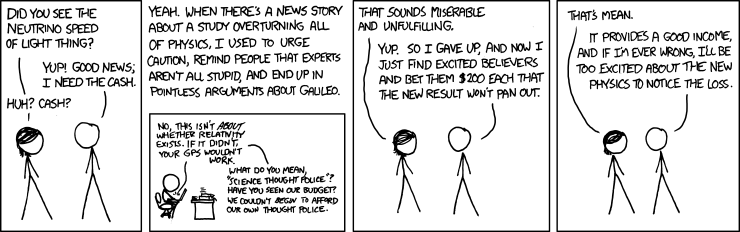
Title: Neutrinos
Title-text: I can't speak to the paper's scientific merits, but it's really cool how on page 10 you can see that their reference GPS beacon is sensitive enough to pick up continential drift under the detector (interrupted halfway through by an earthquake).
Stats: This comic has been referenced 40 times, representing 0.0526% of referenced xkcds.
^xkcd.com ^| ^xkcd sub ^| ^Problems/Bugs? ^| ^Statistics ^| ^Stop Replying ^| ^Delete
u/Sagebrysh [+1] Rank 7 Pragmatist (4 days later)
It's not really an issue of traditional materials vs new physics. These are laws of the universe, any material you use is going to follow the same rules. Of you can just say "It's magic."
I don't like "its magic" as a solution. Even the magic isn't "its magic" in my story.
That sounds rather magical. It would have the effect you wanted, but either it's going to take energy to move the mass away to the pocket or it's going to make energy out of nothing.
It does take energy. It takes electrical energy to shunt the mass-energy in and out of the zero point fields. This action in and of itself isn't CofE violating, the CofE violation emerges as a result of using the variance in mass to produce thrust. The CofE conflict emerges as you can get more kinetic energy out of the system then you put in, in the form of electrical energy. That's only a CofE conflict though in the case of a closed system, which it might not be once you take the ZPF into account.
I could of course just say, "well its fiction" but that's not particularly satisfying, and I'm really not sure its needed. I'd actually be willing to make your 200 dollar bet if I wasn't dirt poor. But, I'll bet you 20 bucks the emdrive actually works. UofDresden and Nasa Eagleworks weren't able to dismiss it despite setting out specifically to prove it doesn't work. No one is sure how or why it works yet, everyone has a different theory, but it does seem to be doing something.
Regardless though, its 100% possible to derive work from the ZPF field. Its not non-interacting and the Casimir Effect proves that very conclusively. We don't have a way to use the Casimir effect yet, but we didn't have a way to use electromagnetism for a long time either. Unlike dark matter, there is actual experimental evidence for the Casimir Effect. The ZPF is a very real thing and we might yet be able to derive essentially free energy out of it yet. So in my story the energy doesn't come from nowhere, and in the real world Casimir derived-energy doesn't come from no where, its energy being extracted from the local zero point fields.
I like MiHsC because it provides a theoretical foundation for a reactionless drive, as providing a solution for the galaxy rotation problem without having to invent dark matter. It also provides a framework for understanding how inertia and acceleration exist. As for being a 'random blogger' Mike McCulloch has a PhD in Physics from Liverpool. He proposes some really interesting stuff and I highly suggest checking him out.
That sort of science isn't hugely rational. I'd much prefer you'd just not tell us what happened than use something like ZPF to explain it. People shouldn't be encouraged to think that single real scientific theories can explain anything and everything.
Conservation of detail is of course always at work, and most of this need never come up in a story that is going to mostly revolve around people, not technology. However, as the author, I want to know the details even if the audience doesn't. It lets me figure out how edge cases would potentially develop and how they'd play out.
u/Nepene [+1] (4 days later)
It does take energy. It takes electrical energy to shunt the mass-energy in and out of the zero point fields.
This action is conservation of energy violating, since a small electrical current is doing a lot more work than it has energy for. The second action, where you push a lighter object around, doesn't violate conservation of energy. Light objects move easily, that's normal in physics.
But, I'll bet you 20 bucks the emdrive actually works.
I'd only accept that bet if you agreed that it has to work (for you to win) via violating conservation of momentum per your statement. "Something to point out though, is that the over-unity function is stealing energy in the form of inertia, much like the equally CofE breaking /r/emdrive. "
Regardless though, its 100% possible to derive work from the ZPF field.
Not really. It's zero point energy. It's already at its lowest energy.
With a very artificial situation you can derive a small amount of energy, by moving metal plates very close together, but it takes far more energy to do that than you gain from the casimir effect.
If your story is going to be advertising perpetual motion machines as a real thing it's not going to be very scientific, and you can make up edge cases as you wish.
I like MiHsC because it provides a theoretical foundation for a reactionless drive, as providing a solution for the galaxy rotation problem without having to invent dark matter[1] .
Dark matter isn't really a big issue, but sure.
As for being a 'random blogger' Mike McCulloch[2] has a PhD in Physics from Liverpool. He proposes some really interesting stuff and I highly suggest checking him out.
I don't have a huge need to read fairly fringe science from someone who doesn't seem that good at explaining it. Maybe he's right, but I don't see any particular reason to believe so. He got a PhD in Physical Oceanography, not astronomy. He's not really a great expert and hasn't done much actual official research.
u/varno2 [+2] (9 hours later)
You need to put this into the context of Noether's theorem. The thing to note here is that energy is not conserved the laws of physics change over time, as the conservation of momentum is broken in the manner in which you have chosen to demonstrate the laws of physics change over distance and over space.
Congratulations you now have a dimension where there is magic. Biology will happily evolve to function using this aetherium. As there is a preferred distance and location general and special relitivity are out of the window. As similarly quantum mechanics is significantly changed, and conservation of information probably does not hold.