mirror of
https://github.com/wassname/rl-portfolio-management.git
synced 2026-06-27 16:46:41 +08:00
 Michael J Clark
162 lines
7.0 KiB
Markdown
162 lines
7.0 KiB
Markdown
Attempting to replicate "A Deep Reinforcement Learning Framework for the Financial Portfolio Management Problem" by [Jiang et. al. 2017](https://arxiv.org/abs/1706.10059) [1].
|
|
|
|
**Note2 (20190525):** vermouth1992 improved this environment during their final project, I reccomend you start with their [repo](https://github.com/vermouth1992/drl-portfolio-management). Also check out the [sagemaker tutorial](https://github.com/awslabs/amazon-sagemaker-examples/blob/master/reinforcement_learning/rl_portfolio_management_coach_customEnv/rl_portfolio_management_coach_customEnv.ipynb) which is based on vermouth1992's work.
|
|
|
|
|
|
Note1 (2018): the paper's authors have put [the official code for the paper up and it works well](https://github.com/ZhengyaoJiang/PGPortfolio)
|
|
|
|
tl;dr I managed to get 8% growth on training data, but it disapeared on test data. So I couldn't replicate it. However, RL papers can be very difficult to replicate due to bugs, framework differences, and hyperparameter sensistivity
|
|
|
|
# About
|
|
|
|
This paper trains an agent to choose a good portfolio of cryptocurrencies. It's reported that it can give 4-fold returns in 50 days and the paper seems to do all the right things so I wanted to see if I could achieve the same results.
|
|
|
|
This repo includes an environment for portfolio management (with unit tests). Hopefully others will find this usefull as I am not aware of any other implementations (as of 2017-07-17).
|
|
|
|
Author: wassname
|
|
|
|
License: MIT
|
|
|
|
[[1](https://arxiv.org/abs/1706.10059)] Jiang, Zhengyao, Dixing Xu, and Jinjun Liang. "A Deep Reinforcement Learning Framework for the Financial Portfolio Management Problem." *arXiv preprint arXiv:1706.10059* (2017).
|
|
|
|
# Results
|
|
|
|
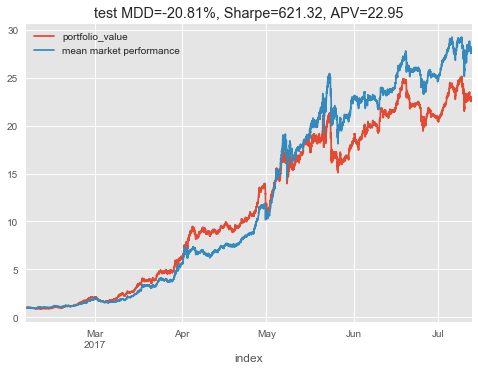
I have managed to overfit to the training data with no trading costs but it could not generalise to the test data. So far there have been poor results. I have not yet tried hyperparameter optimisation so it could be that parameter tweaking will allow the model to fit, or I may have subtle bugs.
|
|
|
|
- VPG model,
|
|
- training: 190% portfolio growth in 50 days
|
|
- testing: 100% portfolio growth in 50 days
|
|
|
|
|
|
|
|
This test period is directly after the training period and it looks like the usefullness of the models learned knowledge may decay as it moves away from its training interval.
|
|
|
|
There are other experiments stored as notebooks in past commits.
|
|
|
|
# Installing
|
|
|
|
- `git clone https://github.com/wassname/rl-portfolio-management.git`
|
|
- `cd rl-portfolio-management`
|
|
- `pip install -r requirements/requirements.txt`
|
|
- `jupyter-notebook`
|
|
- Then open tensorforce-VPG.ipynb in jupyter
|
|
- Or try an alternative agent with tensorforce-PPO.ipynb and train
|
|
|
|
|
|
# Using the environment
|
|
|
|
These environments are dervied from the OpenAI environment class which you can learn about in their [documentation](https://gym.openai.com/docs/).
|
|
|
|
|
|
These environments come with 47k steps of training data and 8k test steps. Each step represents 30 minutes. Thanks to reddit user [ARRRBEEE](https://www.reddit.com/r/BitcoinMarkets/comments/694q0a/historical_pricing_data_for_poloniex_btceth_pairs) for sharing the data.
|
|
|
|
There are three output options which you can use as follows:
|
|
|
|
```py
|
|
import gym
|
|
import rl_portfolio_management.environments # this registers them
|
|
|
|
env = gym.envs.spec('CryptoPortfolioEIIE-v0').make()
|
|
print("CryptoPortfolioEIIE has an history shape suitable for an EIIE model (see https://arxiv.org/abs/1706.10059)")
|
|
observation = env.reset()
|
|
print("shape =", observation["history"].shape)
|
|
# shape = (5, 50, 3)
|
|
|
|
env = gym.envs.spec('CryptoPortfolioMLP-v0').make()
|
|
print("CryptoPortfolioMLP history has an flat shape for a dense/multi-layer perceptron model")
|
|
observation = env.reset()
|
|
print("shape =", observation["history"].shape)
|
|
# shape = (750,)
|
|
|
|
env = gym.envs.spec('CryptoPortfolioAtari-v0').make()
|
|
print("CryptoPortfolioAtari history has been padded to represent an image so you can reuse models tuned on Atari games")
|
|
observation = env.reset()
|
|
print("shape =", observation["history"].shape)
|
|
# shape = (50, 50, 3)
|
|
```
|
|
|
|
Or define your own:
|
|
```py
|
|
import rl_portfolio_management.environments import PortfolioEnv
|
|
df_test = pd.read_hdf('./data/poloniex_30m.hf', key='test')
|
|
env_test = PortfolioEnv(
|
|
df=df_test,
|
|
steps=256,
|
|
scale=True,
|
|
augment=0.00,
|
|
trading_cost=0.0025,
|
|
time_cost=0.00,
|
|
window_length=50,
|
|
output_mode='mlp'
|
|
)
|
|
```
|
|
|
|
Lets try it with a random agent and plot the results:
|
|
|
|
|
|
```py
|
|
import numpy as np
|
|
import gym
|
|
import rl_portfolio_management.environments # this registers them
|
|
|
|
env = gym.envs.spec('CryptoPortfolioMLP-v0').make()
|
|
steps = 150
|
|
state = env.reset()
|
|
for _ in range(steps):
|
|
# The observation contains price history and portfolio weights
|
|
old_portfolio_weights = state["weights"]
|
|
|
|
# the action is an array with the new portfolio weights
|
|
# for out action, let's change the weights by around a 20th each step
|
|
action = old_portfolio_weights + np.random.normal(loc=0, scale=1/20., size=(4,))
|
|
|
|
# clip and normalize since the portfolio weights should sum to one
|
|
action = np.clip(action, 0, 1)
|
|
action /= action.sum()
|
|
|
|
observation, reward, done, info = env.step(action)
|
|
|
|
if done:
|
|
break
|
|
|
|
# plot
|
|
env.render('notebook')
|
|
```
|
|
|
|
Unsuprisingly, a random agent doesn't perform well in portfolio management. If it had chosen to bet on blue then black if could have outperformed any single asset, but hindsight is 20/20.
|
|
|
|

|
|

|
|
|
|
# Plotting
|
|
|
|
You can run `env.render('notebook')` or extract a pandas dataframe and plot how you like. To use pandas: `pd.DataFrame(gym.unwrapped.infos)`.
|
|
|
|
|
|
# Tests
|
|
|
|
We have partial test coverage of the environment, just run:
|
|
|
|
- `python -m pytest`
|
|
|
|
|
|
# Files
|
|
|
|
- enviroments/portfolio.py - contains an openai environment for porfolio trading
|
|
- tensorforce-PPO-IEET.ipynb - notebook to try a policy gradient agent
|
|
|
|
# Differences in implementation
|
|
|
|
The main differences from Jiang et. al. 2017 are:
|
|
|
|
- The first step in a deep learning project should be to make sure the model can overfit, this provides a sanity check. So I am first trying to acheive good results with no trading costs.
|
|
- I have not used portfolio vector memory. For ease of implementation I made the information available by using the last weights.
|
|
- Instead of DPG ([deterministic policy gradient](http://jmlr.org/proceedings/papers/v32/silver14.pdf)) I tried and DDPG ([deep deterministic policy gradient]( http://arxiv.org/pdf/1509.02971v2.pdf)) and VPG (vanilla policy gradient) with generalized advantage estimation and PPO.
|
|
- I tried to replicate the best performing CNN model from the paper and haven't attempted the LSTM or RNN models.
|
|
- instead of selecting 12 assets for each window I chose 3 assets that have existed for the longest time
|
|
- ~~My topology had an extra layer [see issue 3](https://github.com/wassname/rl-portfolio-management/issues/3)~~ fixed
|
|
|
|
# TODO
|
|
|
|
See issue [#4](https://github.com/wassname/rl-portfolio-management/issues/4) and [#2](https://github.com/wassname/rl-portfolio-management/issues/2) for ideas on where to go from here
|